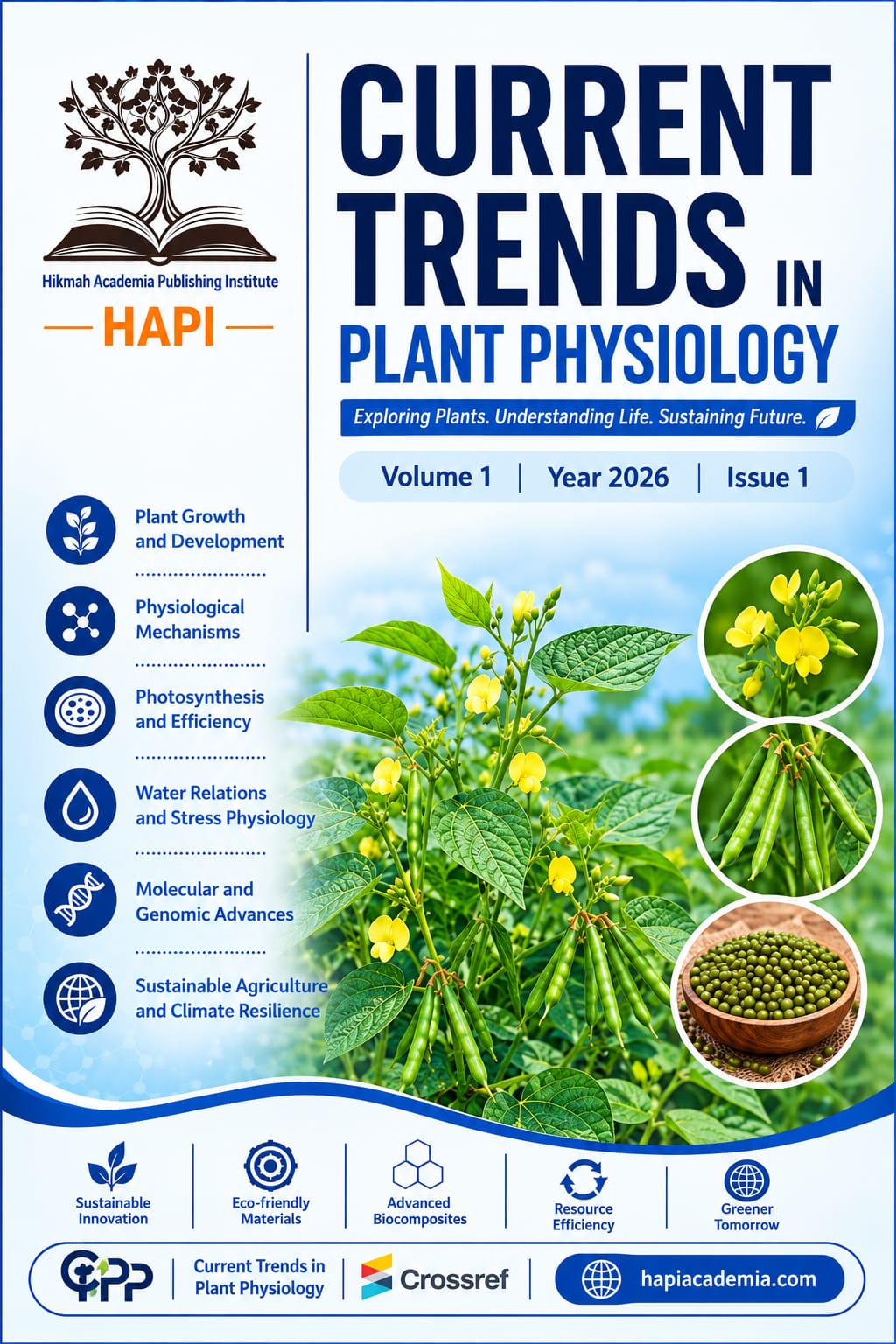
About the Journal
Current Trends in Plant Physiology is a peer-reviewed academic journal dedicated to publishing high-quality research on contemporary developments in plant physiological processes and plant–environment interactions. The journal provides an interdisciplinary platform for researchers, scientists, and academicians to share innovative findings that advance fundamental and applied plant science.
The journal covers a broad range of topics, including plant growth and development, photosynthesis, stress physiology, nutrient uptake, signalling mechanisms, molecular and cellular physiology, and plant responses to biotic and abiotic stresses. Emphasis is placed on integrative and cutting-edge approaches that address global challenges such as climate change, food security, and sustainable agriculture.
Current Trends in Plant Physiology is committed to rigorous peer review, ethical publishing practices, and global dissemination of research that contributes to the advancement of plant biology and agricultural sciences.
The journal focuses on contemporary and emerging research that addresses global challenges such as climate change, crop productivity, stress tolerance, and sustainable agriculture. It encourages integrative approaches combining classical plant physiology with modern molecular, biochemical, and computational techniques.
Scope of the Journal Includes :
-
Plant growth and developmental physiology
-
Photosynthesis and respiration
-
Plant water relations and mineral nutrition
-
Hormonal regulation and signaling pathways
-
Molecular and cellular plant physiology
-
Plant responses to abiotic stresses (drought, salinity, temperature, heavy metals)
-
Plant–microbe and plant–pathogen interactions
-
Stress physiology and adaptive mechanisms
-
Crop physiology and yield improvement
-
Physiological responses to climate change
-
Experimental and applied plant physiology
The journal publishes original research articles, review papers, short communications, and technical notes that demonstrate scientific rigour, novelty, and relevance to plant science research.
Current Trends in Plant Physiology is committed to ethical publishing practices, rigorous peer review, and global dissemination of high-quality research in plant physiological sciences.
Current Issue
Vol. 1 No. 1 (2026): Effect of plant growth regulators on growth, flowering behaviors and yield of Mungbean (Vigna radiata L.)
Background: Mungbean is an important pulse crop valued for its nutritional value and contribution to sustainable agriculture. Plant growth regulators influence the growth and yield of Mungbean; however, information on the combined effects of IAA, GA3, and NAA on Mungbean under field conditions is limited. This study evaluated the effects of different PGR treatments on growth, flowering behavior, and yield of Mungbean.
Methods: The experiment was conducted in the research farm of Sher-e-Bangla Agricultural University, Dhaka, Bangladesh. Nine treatments (untreated control, 50 ppm IAA, 50 ppm GA₃, 50 ppm NAA, 100 ppm IAA, 100 ppm GA₃, 100 ppm NAA, 50 ppm IAA + 50 ppm GA₃ + 50 ppm NAA, and 100 ppm IAA + 100 ppm GA₃ + 100 ppm NAA) were tested in a randomized block design with three replications. Data were recorded on various stages of vegetative growth, flowering traits, and yield characteristics.
Results: The combined 50 ppm treatment (T₇) produced the highest plant height at 60 days after sowing (58.83 cm), number of leaves (31 plant⁻¹), branches (9.33 plant⁻¹), and inflorescences per plant (10), yield per plant (8.33 Kg) and yield (1480 kg ha⁻¹). In general, 50 ppm applications were more effective than the corresponding 100 ppm treatments and control treatments, indicating the importance of optimum hormonal concentration.
Conclusions: The results suggest that combined foliar application of IAA, GA₃ and NAA at 50 ppm can improve reproductive performance and yield of mungbean under the tested field conditions.
Published:
2026-10-13