About the Journal
Plantation Technology is a peer-reviewed academic journal dedicated to the study, development, and application of technologies, practices, and innovations in plantation crops and horticulture. The journal provides a platform for researchers, scientists, agronomists, and industry professionals to share high-quality research aimed at enhancing productivity, sustainability, and economic efficiency in plantation systems.
The journal covers a wide range of topics, including crop management, soil and water conservation, plant nutrition, pest and disease management, post-harvest technology, mechanisation, precision agriculture, and sustainable farming practices. Emphasis is placed on integrative and innovative approaches that improve crop yield, quality, and environmental sustainability.
Plantation Technology is committed to rigorous peer review, ethical publishing standards, and global dissemination of research that contributes to the advancement of plantation agriculture and sustainable crop production.
The journal emphasises the development and application of scientific and technological solutions for plantation crops, covering both traditional and modern approaches to improve crop quality and yield while minimising environmental impact.
Scope of the Journal Includes:
-
Crop management and agronomic practices for plantation crops
-
Soil fertility, plant nutrition, and irrigation management
-
Pest, disease, and weed management strategies
-
Post-harvest technology and storage solutions
-
Mechanization, precision agriculture, and smart farming techniques
-
Climate-resilient plantation practices
-
Sustainable and eco-friendly cultivation methods
-
Biotechnology and genetic improvement of plantation crops
-
Crop modeling, forecasting, and decision-support systems
-
Value addition, processing, and economic aspects of plantation crops
The journal publishes original research articles, review papers, short communications, and technical notes that demonstrate scientific rigour, practical relevance, and innovation in plantation agriculture.
Plantation Technology is committed to ethical publishing, rigorous peer review, and global dissemination of research that supports sustainable, productive, and economically viable plantation systems.
Current Issue
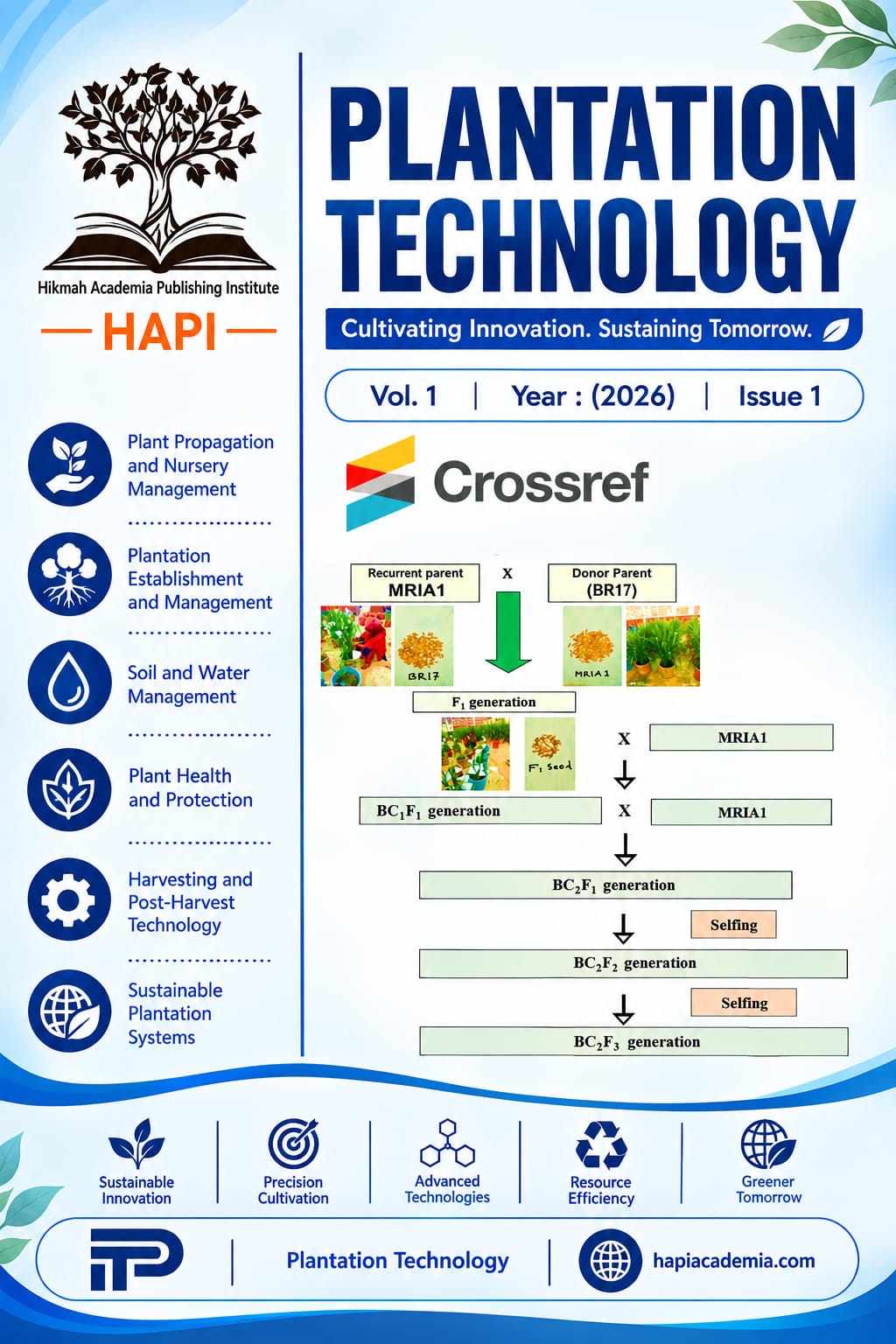
Vol. 1 No. 1 (2026): Introgression of Allelopathic Traits into Drought-Tolerant MRIA1 Rice Variety through Backcross Breeding and Validation via the Relay Seeding Technique
Backcross breeding is a widely used approach for introgressing desirable genes into elite cultivars. In rice production, weeds and drought are two major constraints that substantially reduce rice yield. Although herbicides are commonly used for weed control, their excessive application poses risks to human health, disrupts ecological balance, and promotes the evolution of herbicide-resistant weed populations. Therefore, developing rice varieties that combine allelopathic potential with drought tolerance represents a sustainable breeding strategy for reducing weed pressure while improving climate resilience. The novelty of this study lies in the marker-assisted introgression of allelopathic quantitative trait loci (QTLs) from the Bangladeshi rice cultivar BR17 into the drought-tolerant Malaysian variety MRIA1, followed by the validation of allelopathic performance using the relay-seeding technique and the development of improved allelopathic breeding lines. The experiment was conducted from March 2020 to July 2022 at Ladang 15 and the Seed Technology Laboratory, Faculty of Agriculture, Universiti Putra Malaysia. BR17 was used as the donor parent for allelopathic traits, whereas MRIA1 served as the recurrent parent because of its high yield potential and drought tolerance. Marker-assisted backcross breeding was employed to develop BC₁F₁, BC₂F₁, BC₂F₂, and BC₂F₃ populations through foreground and background selection. The selected BC₂F₂ introgression lines were subsequently evaluated for allelopathic activity to identify superior lines with enhanced weed-suppressive potential while retaining the desirable agronomic characteristics of the recurrent parent. This study successfully developed improved drought-tolerant rice lines with enhanced weed-suppressive potential, providing valuable genetic resources for breeding climate-resilient rice. These findings demonstrate the effectiveness of integrating marker-assisted backcross breeding with phenotypic validation to combine allelopathy and drought tolerance in elite rice backgrounds. The developed lines provide valuable breeding materials for developing climate-resilient, weed-competitive rice cultivars, with the potential to reduce herbicide dependence, support sustainable weed management, and improve rice productivity under changing climatic conditions.
Published:
2026-09-24